Sandy Brondello’s Words Reveal WNBA Deeper Coaching Problem
Sandy Brondello’s Words Reveal The WNBA's Deeper Coaching Problem

If you can see it, you can be it.
This is a long-held belief that first took root for me during my first news job as an intern for a Philadelphia news station. My boss was a Black woman who poured into my development and taught me how to navigate racial dynamics in a way no white manager could.
Seeing how she worked around racism and excelled into the senior ranks of the station proved that I could eventually climb into leadership positions. I have carried her example with me into every leadership role I have occupied.
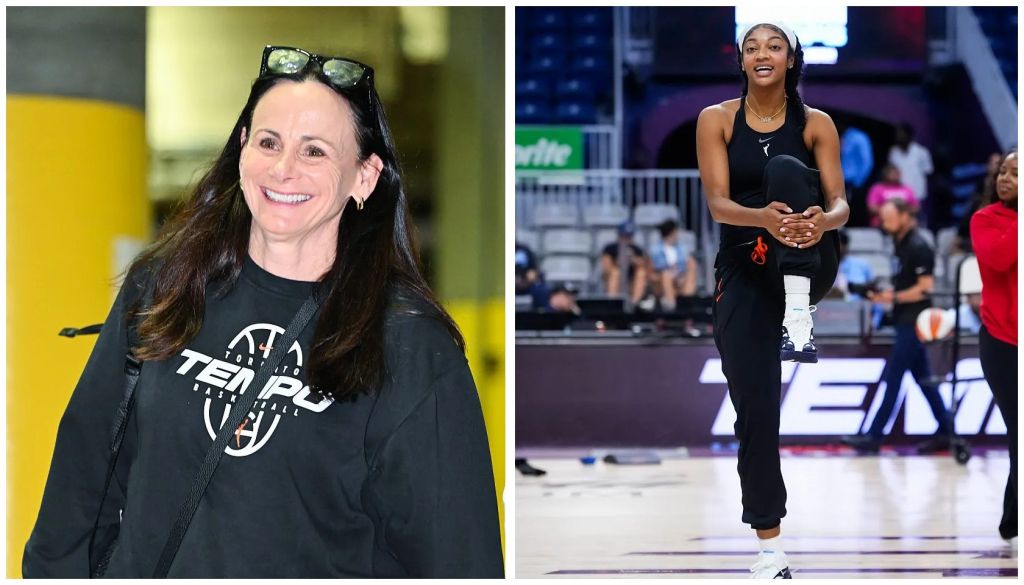
My former boss was on my mind this weekend as I digested what Atlanta Dream star Angel Reese experienced during a game against the Toronto Tempo. Broadcast microphones captured Tempo head coach Sandy Brondello angrily yelling at referees, referring to Reese as a “protected species.”
Reese answered on social media within hours, writing, “Are we surprised?!”
Though Brondello later apologized and received a one-game league suspension, the phrase carries deep, dehumanizing connotations that heavily impact Black women across the league and beyond.
Watching a white head coach weaponize that language on a public stage highlights the unique, volatile workplace dynamics that Black athletes like Reese are forced to navigate.
Reese has already been the target of repeated racial attacks throughout her career, and when this occurred, it was heartbreaking she didn’t have a Black woman coach there to defend her.
For only the third time in its 30-year history, there isn’t a single Black woman head coach on any of the 15 sidelines in the WNBA. This conspicuous absence is particularly astounding in a league where Black women make up more than two-thirds of its players.
What has happened with Brondello has now become Exhibit A of why Black women coaches are sorely needed.
Brondello’s word choice belongs to a history of dehumanizing rhetoric in sports. The phrase “protected species” mirrors this lineage by reducing Reese’s elite talent to an animal comparison that calls for containment and regulation.
A 2024 study in the Journal of Applied Sport Psychology interviewed athletes coached by people of different racial backgrounds. Most players described stronger trust and connection with their Black coaches.
Players also said cultural literacy mattered as much as coaching skill, meaning a Black coach who understands the racial weight an athlete carries can respond to a moment like Reese’s differently than a white coach.
Reese has already lived what having a Black woman coach can mean. Teresa Weatherspoon coached her for one season in Chicago, and the bond outlasted the job. Reese said they built a connection in that one year that would last a lifetime.
While the WNBA has struggled to hire Black women as coaches, it has grown fluent in finding symbolic ways to honor Black women once their playing days are behind them.
In September, the Los Angeles Sparks will unveil a statue of former Sparks star Lisa Leslie, making her the first woman to be immortalized in its plaza.
Leslie had applied to become a coach in the WNBA and was so disillusioned that, after being rejected, she said she wasn’t interested in reapplying, saying, “I did not get picked, and I felt like I would never make another attempt to go into coaching in the WNBA because you know it’s like you’ve gotta be ten times as great, as a Black woman in this industry, and when I tell you that who these people hired is not better than me and what I could do for this team and players.”
Leslie then added, “But it’s ok because I’m very much [sure] that what’s for you is for you, and that’s not for me, and I’m OK with that. So I will never attempt to coach in the WNBA again. Period, I’ve moved on. And I got new contracts.”
Leslie’s rejection aligns with where the league has been steering its hiring. Seven of the WNBA’s 15 head coaches now have NBA coaching experience on their resume, a number that has grown as the league’s audience and paychecks have grown with it.
Men who once treated coaching women’s basketball as a step down are now viewing it as an attractive destination, and franchises have followed by reaching for NBA-tested names over the WNBA’s own coaching and player pipeline.
That pipeline was already thin for Black women, as NBA coaching jobs are scarce and Black women have had limited access to them. A hiring preference for NBA experience adds another obstacle for a candidate like Leslie, prioritizing outside networks over the WNBA’s internal talent pool.
There is a larger corporate pattern that explains how these hiring structures consistently fail Black women. Researchers call it the broken rung. Lean In and McKinsey’s 2025 Women in the Workplace report found that for every 100 men promoted to manager, only 60 Black women get promoted. The report also highlights that Black women receive less management support, less recognition, and less advocacy when a promotion is on the table.
This systemic deficit ensures that when job rejection happens to Black women, it is falsely framed as an individual failure rather than structural exclusion. We are told we fell short or were not the right “fit,” leaving no room to consider whether the doors to the position were ever open to us in the first place.
The teams Leslie applied to haven’t said what kept her out, but the hiring pattern around her offers clues.
When the Storm chose not to bring coach Noelle Quinn back to the Seattle Storm for the 2026 season, the league lost what had been its sole Black woman head coach.
Two expansion franchises, the Toronto Tempo and the Portland Fire, came into the league around that same time, and neither hired her. Meanwhile, Sandy Brondello had parted ways with the New York Liberty and was given the open slot with the Tempo.
A head coach opening for the Dallas Wings was another opening that could have gone to Quinn or Weatherspoon. Fans watched the Wings finish the 2025 season 10-34, tied for the worst record in the league, and head coach Chris Koclanes’ shortcomings felt obvious even from the outside.
The front office viewed his performance and credentials differently. General manager Curtis Miller pushed back on the suggestion that Koclanes wasn’t qualified, saying, “The thing that’s hard for me to listen to is that he’s not qualified,” Miller said. “Behind Cheryl, Sandy and Stephanie White, he’s been in this league coaching longer than anyone else.”
Dallas ultimately fired Koclanes based in large part on player dissatisfaction. His departure should have opened space for a Black woman coach. Instead, the team moved quickly to hire Jose Fernandez, who held strong connections to UConn head coach Geno Auriemma.
The logic in hiring Fernandez seemed to hinge on continuity and institutional familiarity, an old boys’ network that promotes the idea that a coach already approved by the Auriemma ecosystem could better manage the expectations and culture surrounding its young star, UConn alum Paige Bueckers.
While the WNBA continues to leave Black women out as coaches, another basketball league, Unrivaled, has leaned into them. The 3-on-3 basketball league built by two WNBA players, Minnesota Lynx star Napheesa Collier and New York Liberty star Breanna Stewart, entrusted five of its eight head coaching slots this year to Black women. Among them were two Black women coaches, Teresa Weatherspoon and Noelle Quinn, who had been shown the door by the WNBA.
Both Weatherspoon’s and Quinn’s teams made it to the semifinals while also building solid reputations for the ways they poured into their players. Unrivaled’s social media regularly featured Quinn delivering motivational pep talks to her team, showing that her investment in her players extended beyond the basketball court.
Weatherspoon continued her legacy of investing deeply into the next generation of superstars in her hands-on work with Saniya Rivers. Rivers, who had spent her WNBA rookie year grieving the loss of her mother, found a coach in Weatherspoon who built her back up on the court and off of it.
This week, Weatherspoon will take the stage at the WNBA’s All-Star game as an honorary general manager after drafting one of its rosters as part of the league’s 30th season celebration. She’s more than earned that recognition. But, let’s be real. That role is temporary and symbolic. It isn’t the full-time coaching job she deserves.
The WNBA has gotten comfortable finding ways to honor Black women. When it comes to coaches, it needs to start hiring them. It should do so for the sake of its players and for the next generation of Black women who aspire to be head coaches in the W.
They need to see it, so they know they can be it.
SEE ALSO:
Paige Bueckers Says The WNBA Needs Black Women Head Coaches
Caitlin Clark’s White Woman Grievance Spiral Could End Her Career
Sandy Brondello’s Words Reveal The WNBA's Deeper Coaching Problem was originally published on newsone.com